Tool Use and Techniques
There is no defensible universal winner for both fastest chilling and least meltwater based only on the shaker label. Cooling the drink, cooling the vessel and melting ice are linked; compare models at the same final drink temperature and with controlled starting conditions.
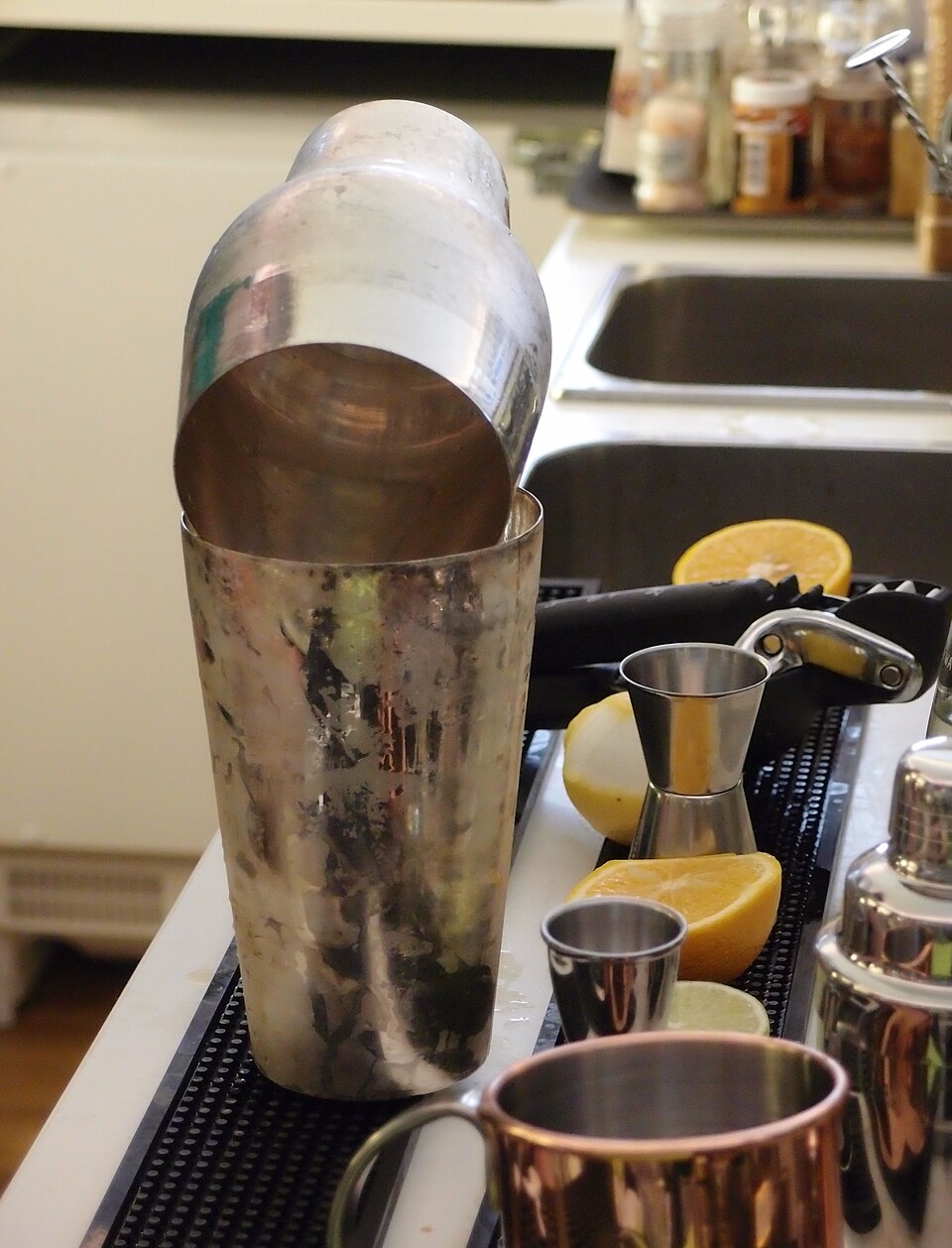
Where the heat goes
During shaking, energy moves between the drink, ice, vessel and surroundings. Ice absorbs energy as it warms and melts. The initially warm parts of the shaker also need cooling. Alcohol and water mixing and the changing drink composition make this more complex than treating a cocktail as pure water at a fixed freezing point.
Dave Arnold’s published Cooking Issues experiments compared shaker configurations and found a lower final temperature with metal than glass under the reported conditions. Those experiments do not constitute a ranking of every modern double-wall model.
Why thermal mass and conductivity are different
Thermal mass describes how much energy a participating part stores for a temperature change; conductivity concerns heat transfer through the material. A heavy warm vessel can add a cooling load. A conductive wall can transfer heat efficiently, including heat from sources you do not want.
For an insulated shaker, the whole item’s weight is not automatically the thermal mass coupled to the drink during a short shake. The inner wall and the isolation between walls matter. Do not infer performance from weight alone.
Compare the three formats
| Format | What matters thermally | What the label cannot establish |
|---|---|---|
| Ordinary stainless tins | Wall mass, starting temperature, contact with the moving drink and ice | A universal cooling time or dilution percentage |
| Heavy double-wall shaker | Inner-wall mass, insulation and the actual construction | That a comfortable outside temperature means the drink is colder |
| Boston glass and tin | The glass’s starting temperature and thermal mass, plus overall geometry | That visibility or a thick wall improves chilling efficiency |
Does less meltwater mean better chilling?
Not by itself. A warmer drink may have received less dilution because less cooling occurred. Compare water gain at the same target temperature, or compare temperature at a clearly stated dilution. Surface water carried in with wet ice can also add water without representing newly melted ice.
Pre-chilling a vessel changes the starting energy balance. If one shaker is chilled and another begins at room temperature, the result cannot be attributed solely to their materials.
A meaningful comparison method
- Use the same recipe volume and initial liquid temperature.
- Control ice mass, size, starting temperature and surface water.
- Use a defined shaking routine and consistent elapsed time.
- Measure drink temperature with suitable equipment and record the handling delay.
- Use a validated dilution measurement method; recovered liquid mass alone is affected by retention and lost fragments.
- Repeat trials and compare uncertainty before declaring a winner.
For buying, secure handling, a reliable compatible closure and practical care remain useful criteria. We have not run a controlled three-model experiment and do not assign invented temperature or water-gain results.
Frequently asked questions
Does a heavier shaker always add more dilution?
No. Its participating inner components, starting temperature and construction matter. Total weight is not enough to predict a short shaking trial.
Does a colder outside prove the drink is colder?
No. Insulation and wall construction affect what your hand feels. Measure the liquid to compare it.
Can chilling the vessel change the result?
Yes. Pre-chilling changes the initial heat load and must be controlled or reported.
Which should I buy without laboratory tests?
Choose compatible parts, comfortable grip and a clear care routine. Do not pay for an unverified universal claim about fastest cooling and least dilution.