DIY Bar Tools
There is no universal hole diameter and pitch that turns any dining spoon into a good Julep strainer. First check bowl size, vessel fit and known material; then calculate a prototype layout and test drainage, strength and cleanability.
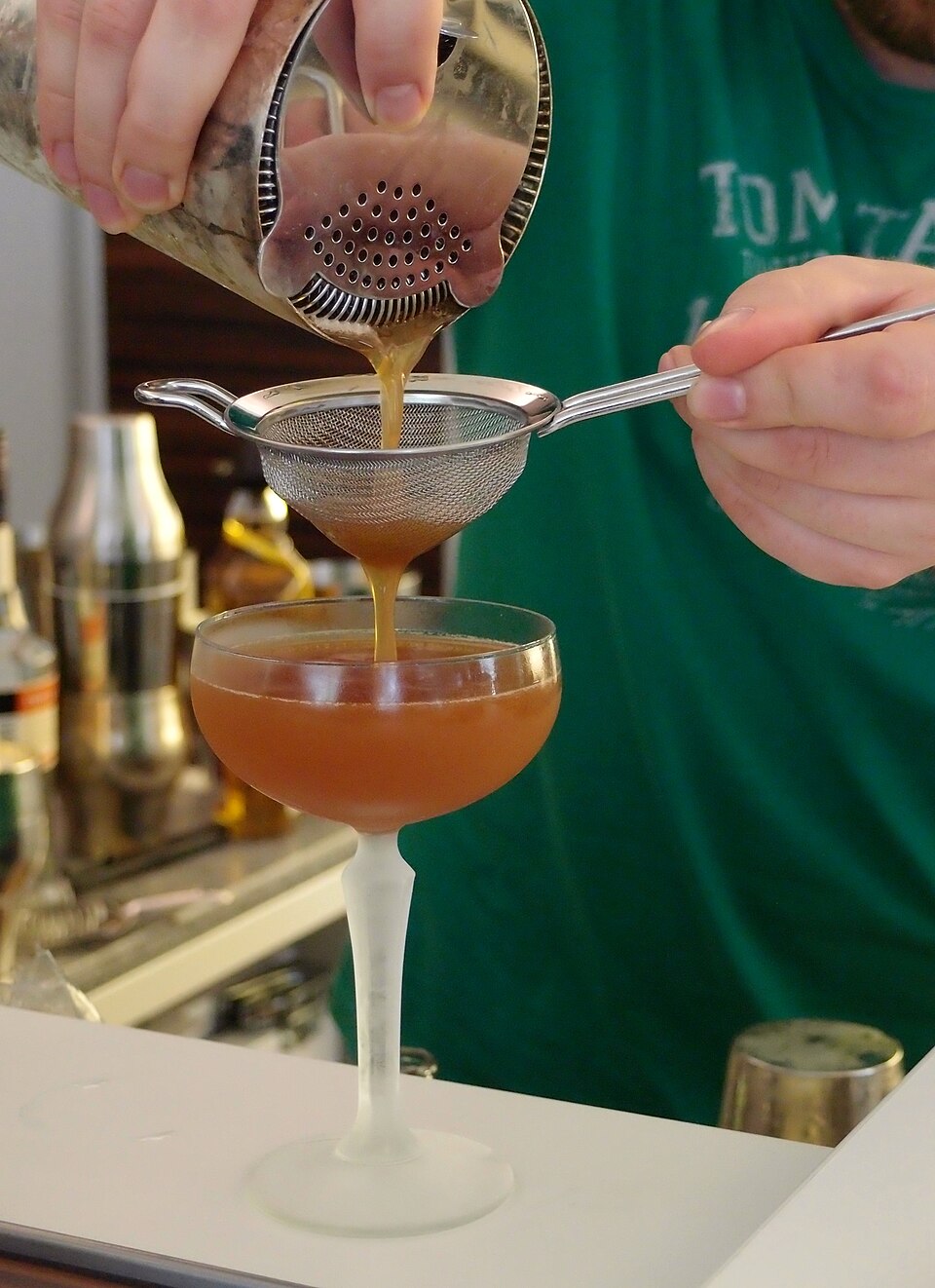
Decide whether the spoon is a suitable blank
A Julep-style bowl must sit securely at the mouth of the mixing vessel and leave a controllable pouring path. A small dining spoon may be the wrong shape before you drill a single hole. Check the handle position, bowl width and working angle against the actual vessel.
Use known solid material suitable for the intended food contact. Do not drill through unknown plating or assume that an exposed underlying alloy is acceptable. If the blank is too thin, damaged or awkward to fixture, choose another project rather than drilling it handheld.
Define diameter and pitch
Let d be the hole diameter and p the centre-to-centre distance between adjacent holes. For equal circular holes on a square grid, the ideal open-area fraction is φ = πd² / (4p²). The remaining web between adjacent holes is w = p − d.
For a staggered triangular grid, the ideal fraction is φ = πd² / (2√3 p²). These are flat repeating-grid geometry equations. A finite curved spoon has edge margins and incomplete rows, so its actual total open area must be calculated separately.
A worked layout example, not a certified specification
With d = 2 mm and p = 4 mm, a square grid has about 19.6% ideal open area and a 2 mm web. A triangular grid at the same diameter and pitch has about 22.7% ideal open area. These values illustrate the calculation; they do not prove a particular spoon will drain well or remain strong.
For a finite layout with N holes in a perforated region of area A, use φ = Nπd² / (4A), provided complete holes lie inside that region. Specify which region A describes. Counting the whole spoon and counting only the perforated zone produce different percentages.
Why open area is not the whole design
More open area can reduce the metal left between holes and near edges. Drainage also depends on liquid depth, ice contact, bowl angle and obstruction. Holes intended to retain ice are not a fine mesh filter for small particles. Keep the handle junction and rim strong enough for the actual design; a universal margin cannot be prescribed without material and thickness information.
Fabrication and finishing checks
Mark and fixture the blank securely, with appropriate backing and drilling equipment for its material. Follow the machine’s procedures and use eye protection. Never hold the curved spoon by hand while drilling.
Deburr both sides and the hole edges, remove machining residue and inspect for cracks and raised metal. A sharp or uncleanable opening is a failed finish. Check that the bowl remains suitable for food contact after fabrication rather than assuming polishing fixes every surface problem.
Test before using it for drinks
Start with water and representative ice in the intended vessel. Check seating, controllable pouring, snagging, ice escape and retained residue. Repeat after cleaning and inspect for distortion. A purpose-made strainer is the simpler choice if the blank cannot achieve a secure fit or a smooth cleanable finish.
Frequently asked questions
Is 2 mm the recommended diameter for every spoon?
No. It is an arithmetic example. The blank, retained solids, thickness, strength and cleaning requirements determine the design.
Does a triangular grid drain better automatically?
It has a higher ideal open fraction at the same diameter and pitch, but actual drainage also depends on the bowl and pouring conditions.
Can I drill a plated spoon?
Do not use unknown plating or substrate for this project. Drilling changes the exposed surfaces and requires verified suitable material.
Can the DIY strainer replace a fine sieve?
No. A perforated Julep-style tool retains larger solids; it does not provide fine mesh filtration.