Tool Use and Techniques
An ice press shapes an existing block by melting away its outer parts against metal moulds. Choose the sphere size, starting ice and serving routine first; then compare materials or commission a machinist with a clear functional brief.
A press is not an ice maker
A passive metal press transfers heat from its body into the ice. As the exterior melts, the halves approach their final position and leave a sphere. It does not freeze water or remove the internal cloudiness of a poorly prepared block. Clear output needs suitable clear starting ice.
Commercial designs use materials including aluminium and copper. Copper’s conductivity can be useful, but whole-device performance also depends on mass, cavity contact, initial temperature, drainage and how the press is used. Metal choice alone does not establish a cycle time.
Choose sphere diameter from the glass
Measure the narrowest opening and useful space inside the intended whiskey glass. Allow comfortable clearance to insert and remove ice, rather than specifying a ball exactly as wide as the opening. Also consider how much room the sphere leaves for the drink.
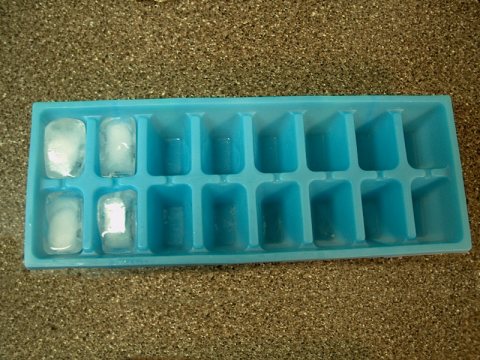
A larger sphere needs a suitable starting block and occupies more freezer space. Compare actual dimensions, not a photograph taken beside an unfamiliar glass. The image on this page illustrates ice preparation rather than a particular press.
What to compare before buying
- Starting-block requirements: dimensions, shape and the way the ice is supported.
- Drainage: meltwater must leave without making the working area difficult to manage.
- Guidance and alignment: the moving half should travel predictably.
- Handling: consider total weight, secure grip and a stable base.
- Repeat service: check the maker’s reset or warming instructions between cycles.
- Cleaning: identify removable parts and permitted treatments for food-contact surfaces.
A useful brief for a custom machinist
Specify the desired finished diameter, the available starting block, maximum overall footprint and intended number of servings. Ask for traceable material suitable for its intended food contact, a cleanable cavity, drainage, alignment and a safe way to lift the moving section.
Two matching hemispheres define the intended form. For example, a nominal 60 mm sphere has a geometric cavity radius of 30 mm in each half. That is a geometry example, not a fabrication drawing: fit, surface finish, drainage, guide clearances and tolerance must be designed and checked by the machinist.
Do not specify an unknown scrap alloy because its colour looks like copper. Agree how machining residues will be removed and how the finished surfaces will be inspected before ice intended for drinks touches them.
Test the prototype as a system
Check alignment and stability first, then use a representative ice block and record starting conditions, cycle time, meltwater handling and sphere fit in the glass. Test repeat cycles as well as the first warm press. Do not force a binding mechanism or add improvised flame heating; follow the engineered operating method.
Frequently asked questions
Will a copper press make cloudy ice clear?
No. It shapes existing ice; clarity depends on the starting block.
Is copper always faster than aluminium?
Material conductivity matters, but device mass, geometry, contact and starting conditions also matter. Compare complete presses under equivalent conditions.
Can I give a machinist only the sphere diameter?
That is insufficient. Specify starting ice, handling, drainage, footprint and intended workflow, then agree the engineering details.
Can I make several spheres without resetting the press?
A passive press cools during use. Follow its maker’s reset instructions and assess repeat-cycle performance rather than relying on the first cycle.