Tool Use and Techniques
No jigger? Use a small graduated measure or proper measuring spoons and keep every quantity in the same unit system. The goal is a repeatable volume, not an impressive free pour.
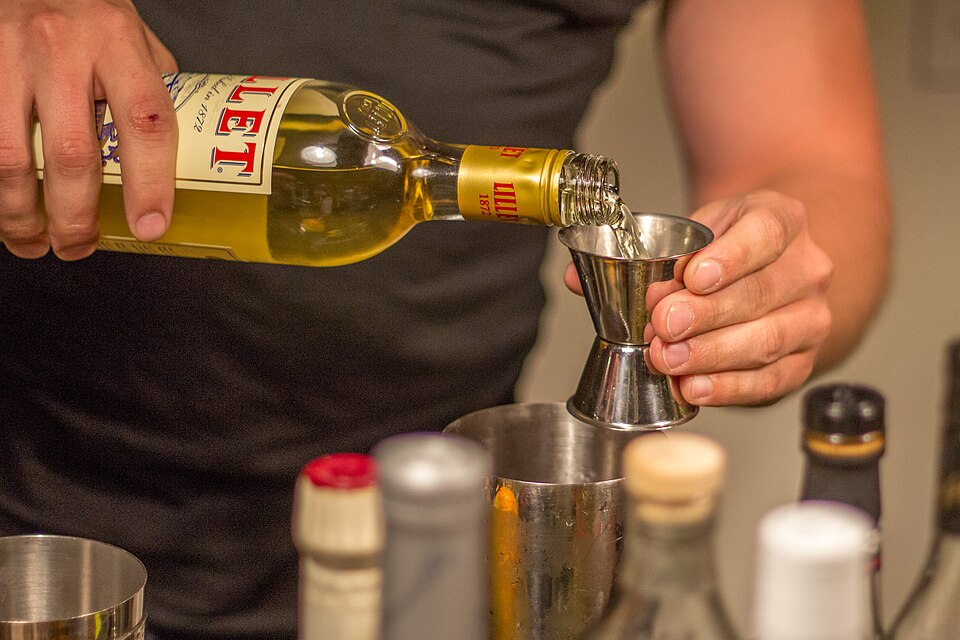
Choose a measure you can actually read
A small kitchen measuring cup with clear millilitre marks is a useful substitute if its scale covers the amounts in the recipe. A large jug may be difficult to read at 5 or 10 mL. Put a flat-bottomed measure on a level surface and check the liquid at the scale’s intended viewing position.
A set of calibrated measuring spoons can handle small quantities. Read the volume stamped on each spoon: do not assume every tablespoon from every country is 15 mL. An ordinary dining spoon is not a calibrated measure.
A practical example using marked spoons
If your measuring tablespoon is explicitly marked 15 mL and the teaspoon 5 mL, you can measure 30 mL as two tablespoons, 20 mL as a tablespoon plus a teaspoon, and 10 mL as two teaspoons. For 45 mL, use three of those 15 mL tablespoons. Keep the fill level consistent and transfer each portion completely.
These are examples in millilitres, not exact conversions of US fluid ounces. A US fluid ounce is approximately 29.57 mL; an Imperial fluid ounce is approximately 28.41 mL. Follow the recipe’s stated system rather than treating them as identical.
What about a shot glass?
Use one only if its working volume or marked scale is known. Shot glasses vary, and the brim may not represent a standard serving. A line that looks decorative should not be treated as a measurement mark without checking it.
Measure before adding ice
- Read the whole recipe and choose one unit system.
- Check that your substitute can measure the smallest ingredient amount.
- Measure each ingredient consistently into the mixing vessel.
- Add ice when you are ready to mix, rather than leaving the drink waiting while you calculate.
When a jigger becomes worthwhile
If you repeatedly need several spoonfuls per ingredient, a readable jigger can reduce the number of transfers. Choose visible graduations and useful capacities rather than a style you find awkward to fill. Consistent technique matters with either tool.
Frequently asked questions
Can I use an ordinary teaspoon?
Use a measuring teaspoon with a stated volume. Dining spoons vary and should not be assumed to hold 5 mL.
Is a shot glass always one ounce?
No. Check its marked capacity; glass size and serving conventions vary.
Can I count seconds while pouring?
A timed pour depends on the bottle, pourer and technique. It is not a reliable substitute for a known volume when learning a recipe.
Should I convert every recipe to millilitres?
You can use a recipe already stated in millilitres. If converting, do so consistently and distinguish US from Imperial fluid ounces.